

TEAM
6
solo

TIME TAKEN
4
weeks

CLIENT

Long Covid Support
Wellbeing Services for Long COVID patients.
Key issue: Lack of symptom management for long COVID patients with mental fatigue and symptoms such as brain-fog
My Role: As a group project, my main contribution was towards the interviews, dairy studies, UX architecture, user flow, prototype, portfolio, and all visual assets

Background
Jo Dainow, a founding member of the Long Covid Support charity came to us with the issue that she and her fellow community members face quite often, mental fatigue. Besides the physiological symptoms, she told us how living with long covid can have behavioural manifestations in the form of confusion, sudden energy loss, and reduced cognition, that drastically affects their quality of life.

Jo promoting the long covid survival guide
Around 80,000 people in the UK left employment due to Long Covid
Drawing from a paper published in 2022, some long covid symptoms are unlikely to affect productivity, but some such as post-viral chronic fatigue, cardiopulmonary symptoms, anxiety and depression can severely hinder the ability to work.
Persistent symptoms vary from case to case
While the most common symptoms include severe fatigue, breathlessness, chest pain or heaviness, fever, palpitations, cognitive impairment (‘brain fog’), loss of sense of smell (anosmia), loss of sense of taste (ageusia), skin rash and joint pain or swelling, it is hard to predict the prevalence, persistence or occurrence which makes it difficult for patients to navigate their symptoms.
Mental fatigue can be really confusing
Mental fatigue and subsequent challenges faced from this symptom spread across a range of physical, physiological, behavioural, and mental health pretexts based on the context. These include inability to go about day-to-day functions, having anxiety, facing a lack of social experiences and inability to work with the same concentration.
Research
We sent across a screening survey to approx 80 people with long covid. This screening was to filter participants that suffer from or have suffered symptoms of mental fatigue. We also conducted dairy studies with 2 of them over a period of 2.5 weeks.
Our user group are individuals varying in ages 20 years and older. Some of the questions we set to to answer were:
-
How might we make long covid patients feel at ease and less anxious about their symptoms and daily challenges with mental fatigue by providing comforting solutions to ease their pain?
-
How might we provide a service that helps patients with long-covid, particularly symptoms of mental fatigue, where they feel they can connect with others who have suffered too?
-
How might we provide a service that helps people track their symptoms to help them record how they are getting better so they can record what patterns and mechanisms might help with their symptoms?


Participant interview data
Findings
Root Cause Analysis // Problem Evaluation Matrix //
Stakeholder Map // Business Value Proposition //
After conducting both secondary and primary research, main problems experienced daily were identified as:
-
Lack of ability to access community support
Users have mentioned they struggle with being able to connect with others who have experienced similar symptoms and where they see the benefit in being able to support each other and provide guidance.
-
Lack of awareness of coping mechanisms and strategies to address mental fatigue. Users have specified, they are unaware of the differing coping mechanisms that may help them, and which strategies work best for them. Interviewees expressed usefulness in becoming more aware through professional and peer community recommendations.
-
Not being able to concentrate as well on cognitive tasks
Users have expressed, they struggle with being able to complete strenuous cognitive tasks either at work or other activities such as reading, writing, art, and other hobbies.
-
Peer and professionals not being believing the severity of patient symptoms
Users have specified they often feel a lack of tolerance and understanding of those such as their peers and professionals who are not experiencing these challenges and not believing them causing heightened anxiety.
-
Missing out on social and professional experiences
Due to the social distancing nature of the illness as well as their inability to engage in
social experiences as part of a support community.
-
Anxiety because of short- or long-term memories becoming less distinct
Users have expressed that brain fog has hindered their ability to relay memories. Where users expressed the need for techniques to help them retain and review previous memories and information more easily.

We looked into the root causes of the issues we discovered and brainstormed solutions that can help with the collective symptoms of lack of community, missing social interactions, coping mechanisms, lack of tracking tools, anxiety from memory loss, and fighting social stigma. The final derivations included community support, coping activities, and a symptom tracker.

In order to determine the features that could be implementable in the MVP, we mapped all the issues users faced on four quadrant graph of level of pain and effort to fix. Lack of community support, social experiences and coping mechanisms were the one's chosen.

We used a stakeholder map in order to understand the actors involved in implementing the features of symptom tracker, community meet-ups, and coping mechanisms. GP practice, IT services, and psychologists/therapists were some of the external stakeholders identified.
Service Design and UX
Information Architecture // User Flow // Screens //
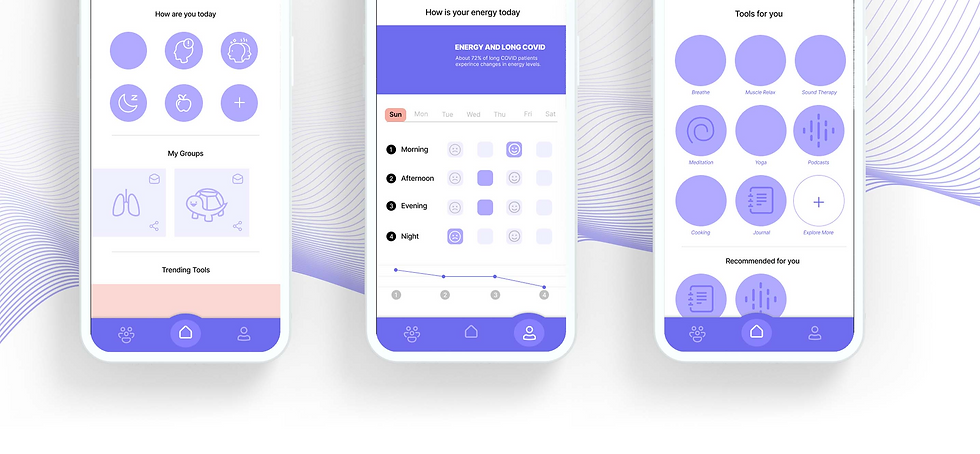
ENDUE was prototyped as a digital service allowing users to track symptoms via a wellbeing tracker, and the ability to connect with patients in their area or from afar with similar experiences, whilst receiving tailored suggested coping strategies for addressing mental fatigue.
1. Onboarding incentive
New members signed up will receive a 'Care Package' containing items addressing their problems such as a gratitude journals to remind themselves of positive things in their life.
2. Wellbeing Tracker
Once registered, users can use the ‘Wellbeing Tracker’ which allows the recording of symptoms and challenges throughout the day, in relation to the categories Appetite, Sleep, Mood, Anxiety, and Energy.
3. Coping Mechanisms
The ‘Tools’ feature is a collection of coping mechanisms that fall under Breathing, Meditation, Medical Help and More. These tools are recommended to users based on location and symptoms experienced.
4. Social Interactions
‘Community Connect’ connects users with other long-covid patients. This is through private insights, with secure one-on-one interactions, or group insights, where discussions and recommendations can be accessed.
5. SOS
Lastly, the SOS feature provides users comfort in knowing they can quickly alert the correct people and services if there was a real emergency, reducing their anxiety around the disease.

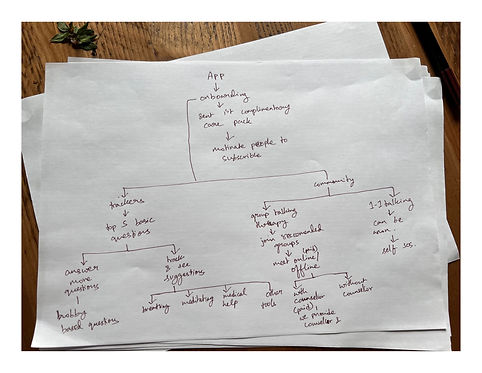

The User Flow focused on providing customisation to the tracker, and the coping recommendations based on user input


Interested? Read the full report here